Jainism (जैन धर्म)
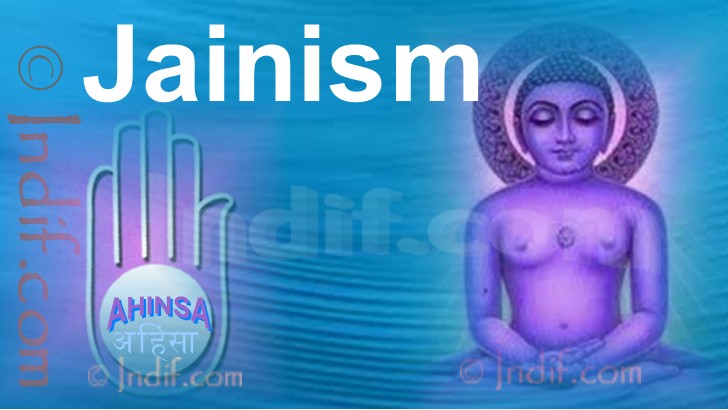
The word "Jain" is derived from the Sanskrit jina, meaning "conqueror", an epithet given to the twenty-four Tithankaras (Ford makers), who, through austerity, conquered their minds, bodies and passions to attain deliverance from the endless cycle of birth. Jainism stresses spiritual independence and equality of all life with particular emphasis on non-violence. It is generally believed that the Jainism is divided into two major sects, Digambar and Shvetambar. Mahavira, last of the twenty-four Fordmakers, was the greatest of all jain ascetics.
The word "Jain" is derived from the Sanskrit
word jina, meaning "conqueror" or
"victory." Thus, Jainism is the religion of the "victorious
one" - any human being who by his or her own effort has
conquered the lower passions and thus become free of
attachments to any materialistic things....
Navkar Mantra is the universal prayer of Jainism. The Navkar Mantra is the most important mantra in Jainism and can be recited at any time. This mantra is also called Namaskar (नमस्कार) or Namokar (णमोकार) Mantra. ...
Mantras are a significant part of Jain worship and
ritual. Every Jain recites the couplet with the
three adorable, everyday reverentially before
starting the study of religious texts....
The Daily Prayers of Jain. One of the most important
Jain prayers is the Namaskara Sutra which praises
the five great beings of Jainism. The prayers of
Forgiveness, Friendship, and Gratitude in Hindi and
English Text with their meanings ....
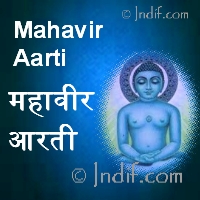
Lord Mahavir was the twenty-fourth and the last
Tirthankara of the Jain religion.Mahavir was born in
599 B.C. as a prince in Bihar, India. His full name
is Vardhamana Mahavir. He was born of Sidhartha, the
Raja of Kundalpura, and Queen Trishala,...
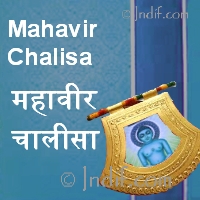
Lord Mahavira, a great spiritual hero, is considered by Jain's to be the last Tithankaras. His life is celebrated in legends and festivals and is considered as a model for all Jain's.
Shree Mahavir Chalisa, is a beautiful forty-verse
prayer, full of praise and plead
with devotion of Mahavir Prabhu....
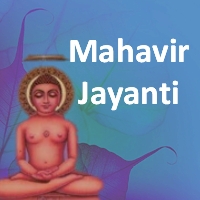
Mahavir Jayanti marks the birthday of Mahavira, founder of the modern Jain religion and the last in the galaxy of 24 Teerthankaras (Jain Prophets).He was born on the 13th day of the rising moon of Chaitra, in either 599 BC or 615 BC .....
The Jain calendar is a “Lunisolar” calendar. It is based on the position of the Moon with respect to the Earth and it is adjusted by adding an extra month once every three years, ,to coincide with the Sun. Here we present a date-wise list of jain festivals.....
Jains use the following eight items to perform puja of a Tirthankara in the temple. Symbolically each item represents a specific religious virtue and one should reflect on it while performing puja.
Jala Puja: Water
Chandan Puja: Sandal-wood
Pushpa Puja: Flower
Dhup Puja: Incense
Dipak Puja: Candle
Akshat Puja: Rice
Naivedya Puja: Sweet food
Fal Puja: Fruit