
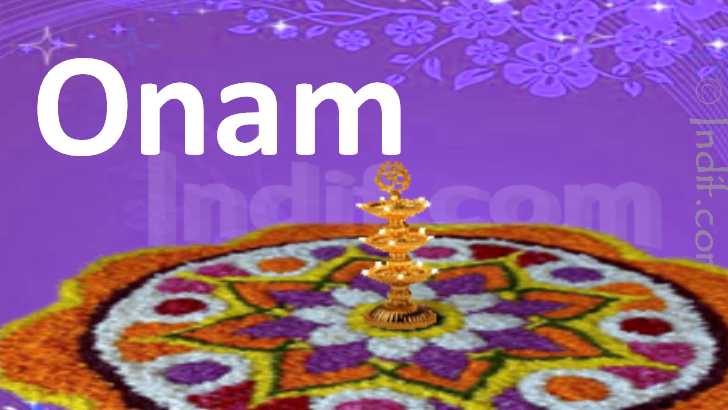

Onam, a harvest festival, is celebrated in Kerala, a state in India. Onam is an occasion for Keralities to celebrate plenitude and togetherness. It is linked with the legend of the mythological king Mahabali. It generally falls in the months of August-September.Ranging from four days to ten days, all the activities during this season are centered around worshipping, music, dances, sports, boat races and good food.
During these days children prepare floral designs called Pookkalam in front of their houses to welcome Onathappan (King Mahabali). Thiruvonam, the tenth day, is the most auspicious. On this day all members of the family gather together, usually at the ancestral home for Sadya - the traditional lunch served on plantain leaves.
The story of King Mahabali:
A long long time ago, an Asura (demon) king called Mahabali ruled Kerala. He was a wise, benevolent and judicious ruler and beloved of his subjects. Soon his fame as an able king began to spread far and wide, but when he extended his rule to the heavens and the nether world, the gods felt challenged and began to fear his growing powers. Presuming that he might become over-powerful, Aditi, the mother of Devas pleaded with Lord Vishnu to curtail Mahabali's powers. Vishnu transformed himself into a dwarf called Vamana and approached Mahabali while he was performing a yajna and asked for alms. Pleased with the dwarf brahmin's wisdom, Mahabali granted him a wish. The Emperor's preceptor, Sukracharya warned him against making the gift, for he realized that the seeker was no ordinary person. But the Emperor's kingly ego was boosted to think that God had asked him for a favor. So he firmly declared that there is no greater sin than going back on one's promise. He kept his word. The Vamana asked for a simple gift three paces of land and the king agreed to it. Vishnu in the guise of Vamana then increased his stature and with the first step covered the sky, blotting out the stars, and with the second, straddled the netherworld. Realising that Vamana's third step will destroy the earth, Mahabali offered his head as the last step. Vishnu's fatal third step pushed him to the netherworld, but before banishing him to the underworld Vishnu granted him a boon. Since he was attached to his kingdom and his people, he was allowed to return once a year from exile. Onam is the celebration that marks the homecoming of King Mahabali. It is the day when a grateful Kerala pays a glorious tribute to the memory of this benign king who gave his all for his subjects.
The story of Palliodam boat:
Once when some men were sailing on a boat called Palliodam, which was laden with food, it got stuck in the narrow turning of the river. The head oarsmen called Bhattathiripad set out to seek help from the hut near the river. However, when he reached there he found a poor widow and her children weeping because of hunger and poverty. The kind-hearted man took some food from his boat and gave it to them. As soon as it was done, the boat could be easily maneouvered to the main course of river again. Since that day, it has become a tradition to feed a poor person at least on the day of Onam.
Another Legend :
Another legend has it that King Mahabali was a devout worshipper of Lord Vishnu. He was sincere, honest, just and a good ruler. But he had one weakness ego. And to eradicate his pride and redeem his beloved devotee of this one sin, Vishnu came to earth in the form of a dwarf Brahmin named Vamana. The king in his pride asked the Brahmin what he wanted for he could give anything. Vamana asked for three paces of land and the king agreed. To humble him Vishnu, as Vamana showed Mahabali that he is just a puny creature in front of God's universal stature. Mahabali, who was a man of principles, realized God's purpose and offered his head for Vamana's footstep, as he was sent to another world. This fatal step proved a blessing in disguise for the good king the foot salvaged and released him from the recurrent cycle of birth and death. That is why Onam is celebrated by wearing new clothes and resolving to lead a new life of truth, piety, love, and humility.
The Celebrations:
The festivities commence 10 days before Onam. The whole of Kerala puts on a jovial show for the reception of Bali so that he may rejoice, seeing his people happy. Two square pyramids representing Vishnu and Bali are erected in courtyards and worshipped with offerings of flowers, fruits and other auspicious food products. A spectacular procession exhibiting caparisoned elephants is taken out in Thrissur.
Here the end of Onam is marked by a magnificent display of fireworks. On the greens of Cheruthuruthy, Kathakali dancers don brilliant costumes and re-enact the stories of epic heroes and virtuous women of substance. Tiger dances, known as Pulikali or Kuduvakali, are a common sight during Onam. Performers, usually young boys, paint themselves like tigers in bright yellow, red and black, and dance to the beats of instruments.
Every home is embellished with floral decorations called pookkalam. Onam feasts include banana erucherry, tomato pachadi, chana dal payasam, and aviyal.
 Collection of Hindu Vrat and Upavas Kathas