
Source : Complied from various published articles on Upnishads
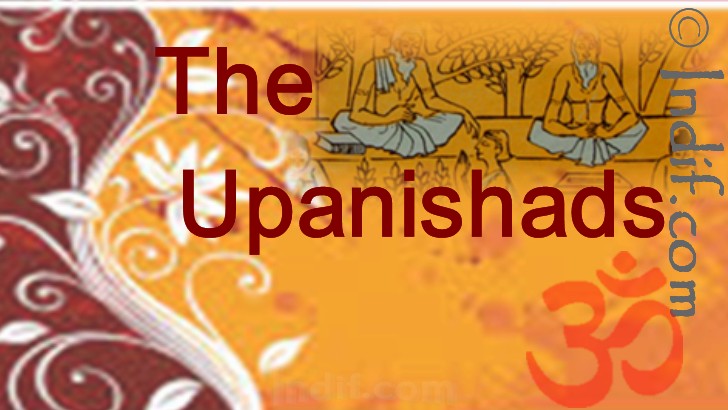
The Upanishads is a collection of texts that were composed mainly between the 7th and 5th centuries BC. They form the last part of the Vedas, the sacred text of the Aryans, and are called Vedanta (Conclusion of the Veda). But they are very different in content and tone from the earlier vedas.
The Sanskrit term Upanisad derives from upa (near), ni(down) and shad(to sit), i.e. referring to the "sitting down near" a spiritual teacher (guru) in order to receive instruction in the Guru-shishya tradition. They represented secret teachings reserved for those who sat near their Guru in the forest. In the Upanishads, philosphical and mystical questionings replace earlic vedic concerns with ritual sacrifice. Rather than invoking external gods, the Upanishads look for a god within, so that the emphasis moves from the acts of sacrifice to the search for the sacred force (brahman) that lives in all things. The Prime concern of most of the Upnishads is the desire for release (moksha) from transmigration. This was to be gained through editation, yoga nad asceticism, to unite the atma (soul) with the brahman. It is here that we find all the fundamental teachings that are central to Hinduism � the concepts of 'karma' (action), 'samsara' (reincarnation), 'moksha' (nirvana), the 'atman' (soul), and the 'Brahman' (Absolute Almighty).
Traditionally, there are 108 Upanishads (major), which are as follows:
1. Twelve major Upanishads,
- Aitareya and the Kauhsitaki which belong to Rig Veda.
- Chandogya and Kena to Samaveda.
- Taittiriya, Katha, Shvetashvatara, Brhadaranyaka and Isha to Yajur Veda.
- Prashna, Mundaka and Mandukya to Atharvaveda.
2. Twenty�three samanayayuvedanta Upanishads
3. Twenty Yoga Upanishads
4. Seventeen samnyasa Upanishads
5. Fourteen vaishnava Upanishads
6. Fourteen shaiva Upanishads
7. Eight shakta Upanishads
8. If there are more than 200 texts titled as Upanishads, it is advised to stick to the traditional, specially, to the Vedic Upanishads.
List of traditional Upanishads:
- Ishavasya (major)
- Kena (major)
- Katha (or Kathaka) (major)
- Prashna (major)
The language of the Upanishads is Sanskrit. The oldest Upanishads, the Brhadaranyaka and the Chandogya are composed in prose.Later followed a series of Upanishads composed in verse, such as the Isha, Mandukya, Katha, and Shvetashvatara Upanishads.
Those who know they are neither body nor mind but the eternal Self, the divine Principle of existence, find the source of all joy and live in joy abiding. I see the gates of joy are opening for you.
- the Katha UpanishadFrom the unreal lead me to the real.
From darkness lead me to light.
From death lead me to immortality.
- the Brihadaranyaka UpanishadTruth alone triumphs, not untruth. By truthfulness the path of felicity is opened up, the path which is taken by the sages, freed from cravings, and which leads them to truth's eternal abode.
- the Mundaka UpanishadEvery person should live a complete life span of hundred years. And he should constantly strive to fulfill the purpose of life i.e. Self-Realization.
- the Isha UpanishadAs long as there is separateness, one sees another as separate from oneself, hears another as separate from oneself, smells another as separate from oneself, speaks to another as separate from oneself, thinks of another as separate from oneself, knows another as separate from oneself. But when the Self is realized as the indivisible unity of life, who can be seen by whom, who can be heard by whom, who can be smelled by whom, who can be spoken to by whom, who can be thought of by whom, who can be known by whom? Maitreyi, my beloved, how can the knower ever be known?
- the Brihadaranyaka Upanishad, II:4:14The one fact I found is that in all the Upanishads,
they begin with dualistic ideas,
with worship and all that,
and end with a grand flourish of Advaitic ideas.
- Swami Vivekananda