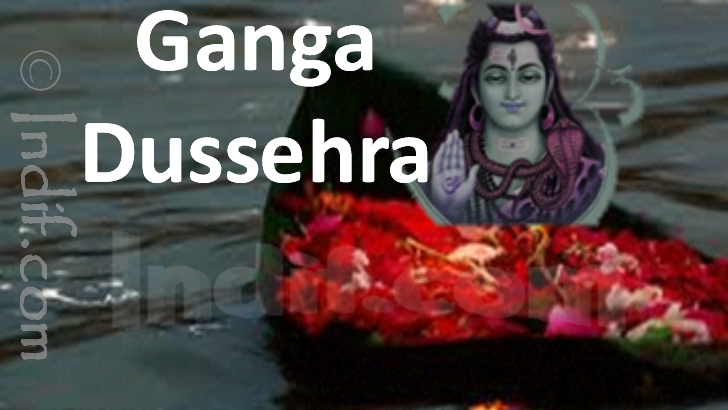

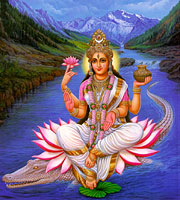
Ganga Dussehra, held over the first 10 days of the month of Jyeshtha (in June), celebrates Gangavataran - the descent of the Ganga to earth. The Ganga, largest of India's rivers and the most sacred to Hindus, holds a unique place in Indian consciousness. Regarded as a celestial river originating in the heavens, she is worshipped as the mother who washes away all the sins of mankind.
The first ten days of the month Jyeshtha, known as Dashahara, are dedicated to honour the river Ganges. It is believed that if one offers prayers on this day, one attains salvation from ten sins. The festival's name Dussehra is derived from 'Dus' which connotes ten and ' hara' which means defeat. Thus the name Ganga Dusshera.
Celebrations:
During this festival ten days of the month are devoted to the worship of Holy River Ganga venerated by the Hindus as a mother as well as a goddess, particularly by people of Uttar Pradesh, Bihar, and Bengal through which the river flows. Devotees flock to Rishikesh, Haridwar, Garh-Mukteshwar, Prayag, Varanasi to meditate and take a holy dip. They take the river clay home to worship.
In the evening, thousands of leaf boats laden with flames, flowers, and sweetmeats are offered to the river and they flow with the current to the sounds of the bells and bhajans, kirtans and shlokas recited during the aarti.
On this day, if a devotee is unable to visit and bathe in the river Ganga, then Ganga jal (water) kept in most Hindu homes is used for purification. A bath in the river is said to purify the bather of all sins. The Ganga is revered all over India even in places far from its course.
Legend of Ganga Dussehra:
 |
According to the legend, King Sagara of the Ikshvaku dynasty ruling at Ayodhya had two queens, Keshani and Sumati, but neither had a child. Sagara performed severe austerities before his wives could produce sons. But whereas Keshani gave birth to a son called Asmajas, Sumati bore 60,000 sons. Sagara performed the Ashwamedha sacrifice to declare his suzerainty over the neighboring kingdoms. According to the prevalent custom, the sacrificial horse were let loose and allowed to wander into the neighboring kingdoms.If the horse was caught, a battle ensued and the outcome decided the winner. The 60,000 sons of Sagara were following the horse when they saw him enter a cavern where sage Kapila was meditating. Not seeing the horse in the cavern, they presumed that Kapila had captured it. They did not kill Kapila as he was a sage but they started disturbing his meditations. |
Annoyed at being disturbed, Kapila with a curse burnt the 60,000 sons of Sagara. Time passed and later Bhagiratha, the great grandson of Sagara, chanced to come across the bones of his dead ancestors. He wanted to perform the shraddha of his ancestors but there was no water available for the ceremony. Agastya having drunk all the waters of the ocean, the country was passing through a severe drought. Bhagiratha prayed to Brahma, the Creator, to end the drought. Brahma asked him to pray to Vishnu to allow Ganga that was sourcing from his toe, to come down to earth.
Vishnu when prayed to by Bhagiratha agreed, but asked him to request Shiva, the third member of the Hindu trinity of Gods, to allow the torrential rain to fall on his head before it came to the earth as the river was very forceful and if she were allowed to come down unchecked, her fall would split the earth. Shiva agreed to take the gigantic weight of the cascading Ganga on the matted hair piled high on his head. This ensnared and delayed the progress of the river and flowed to the plains bestowing its waters on the parched earth.
The Ganga, especially, is the river of India, beloved of her
people, round which are intertwined her memories, her hopes
and fears, her songs of triumph, her victories and her
defeats. She has been a symbol of India's age-long culture
and civilization, ever changing, ever flowing, and yet ever
the same Ganga
- Pandit Jawahar Lal NehruIf Ganga lives, India lives. If Ganga dies, India dies.
-Dr. Vandana Shivaji (renowned environmentalist and GAP member)The Mississipi, the Ganges, and the Nile…the Rocky Mountains, the Himalaya, and Mountains of the Moon, have a kind of personal importance in the annals of the world.
― Henry David ThoreauThe sacred river Ganges in India is one of the most enduring images of the country.
-Daniel LakGita and Ganga constitute the essence of Hinduism; one its theory and the other its practice.
-Swami VivekanandaThe Ganga to me is the symbol of India’s memorable past which has been flowing into the present and continues to flow towards the ocean of the future.
-Pandit Jawahar Lal Nehru