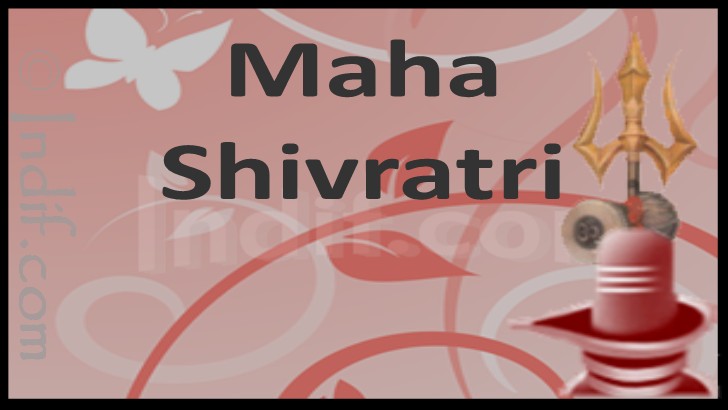

Maha Shivaratri, the night of the worship of Shiva, occurs on the 14th night of the new moon during the dark half of the month of Phalguna. It falls on a moonless February night, when Hindus offer special prayer to the lord of destruction. Shivaratri (Sanskrit 'ratri' = night) is the night when he is said to have performed the Tandava Nritya or the dance of primordial creation, preservation and destruction. The festival is observed for one day and one night only.
Shivaratri, one of India's biggest festivals, honors, the power of Shiva Linga. Long ago a hunter killed too many animals and birds to carry them all home before dark, so he spent the night terrified and hungry up a tree. It was the night when there was no moon in the month of phalgun (February / March) - a sacred night to Shiva. The hunter's constant trembling caused petals and dew to fall from the tree on to a linga beneath, and the god was pleased. When the hunter home and died on the following day. Shiva decreed that, since the man had worshipped the linga on the night of Shivaratri, he was fit to spend his after life on mount kailash.
Shiva the "Great God"
It is probable that, long before the arrival of the Aryans, the "great god" ("Mahadeva" or "Maheshvara") was wor-shipped in India. Mount Kailas in the Himalayas is the abode of Shiva. "The Ganges came down from the heavens because Shiva bore on the matted locks of his head the forceful impact of her falling torrents."
"He creates and destroys, he sustains the world, he at times obscures by his power of illusion (maya), or offers grace to the suffering world. These are the fivefold activities of Siva, symbolised by the five faces of the god (Pancanana). He sees the past, the present and the future by means of his three eyes (Trilocana). To save the earth, he drank the poison and his throat became dark-blue (Nilakantha). A moon's crescent round or above his central eye (Candrasekhara), clad like an ascetic with a tiger-skin, he holds a trident (Pinaka) in his hand; he rides the bull Nandi. Some of his images represent him as a four-armed person-age, two of the hands holding a battle-axe (khadga) and a deer, the two other hands in poses signifying assurance of safety and liberality; in some other representations, he carries a bow, a thunderbolt, an axe, a skull-capped staff, a drum."
Shiva"s family is composed of his wife Uma (Sakti) and their two sons Ganesh and Kartikeya (Subrahmanya). Their respective mounts are the bull, the lion, the mouse and the peacock.
The stone in its spherical form untouched by the sculptor, is the form nearest to the formless. And the sexual union of male and female is the farthest the human mind can reach to express the creative action of God. This action, as God Himself, remains a mystery to man. All that man can do is to look at nature and see how a new being comes into existence. Since nature is the work of God, it is logical to conclude that both the male and the female principles must be found in God Himself, the sexes being only a manifestation of God"s nature. At the level of symbolism, the Shiva Linga or the stone with the semi-spherical top, makes a positive contribution in man"s effort to express the Divine Mystery.
Shiva Rituals:
On the
day of Shivaratri, a three-tiered platform
is built around a fire. The topmost plank
represents swargaloka (heaven), the middle
one antarikshaloka (space) and the bottom
one bhuloka (earth). Eleven urns or kalash,
are kept on the swargaloka plank symbolising
the eleven manifestations of the Rudra
Shiva. These are decorated with bilva
(woodapple leaves) and mango leaves atop a
coconut representing the head of Shiva. The
uncut shank of the coconut symbolizes his
tangled hair and the three spots on the
fruit Shiva's three eyes.
The Festivity:
People
observe a strict fast on this day. Some
devotees do not even take a drop of water
and they keep vigil all night. The Shiva
Lingam is worshipped throughout the night by
washing it every three hours with milk,
curd, honey, rose water, etc., whilst the
chanting of the Mantra "Om Namah Shivaya"
continues. Offerings of Bel leaves are made
to the Lingam as Bel leaves are considered
very sacred and it is said that Goddess
Lakshmi resides in them.
Prayers for Maha Shivaratri:
Legends behind Shivaratri:
Once Lord Vishnu and Lord Bramaha argued over each other's prowess. However, Lord Shiva challenged both of them. He appeared as a flaming Linga and challenged the duo to measure the gigantic Linga (phallic symbol of Lord Shiva). Lord Bramaha, who took the form of a swan, and Lord Vishnu who became a boar and went to Netherland, were both unable to measure the Shivalinga. Then Lord Shiva came out of the Linga and declared himself the most powerful. Maha Shivaratri therefore means the grand night of Shiva. The devotees of Shiva fast during this day and pray to the lord throughout the night. This legend goes to prove the supremacy of Mahadev over other Hindu Gods.King Daksha, opposed Sati's marriage with Shiva. At a yagna (holy sacrifice) the king ignored Shiva's presence and thereby insulted the latter publicly. Sati was so angered by this that she jumped into the sacrificial fire and ended her life. Lord Shiva unleashed his fury at the death of his wife by performing the violent dance, Taandav. He wiped out Daksha's kingdom, undertook rigorous penance and retired to the Himalayas. The Gods, who feared that the severity of Shiva"s penance might bring an end to the world, revived Sati in the new avatar of Parvati. Shiva-Parvati married and this reunion is celebrated on Maha Shivaratri.
Twelve Jyotirlingas:
The Shiva Linga is the most common object of worship all over India. But twelve such stones are considered more important and are known as Jyotirlinga. They are situated in the following places:
- Omkareshwar in Madhya Pradesh;
- Rameshwar in Tamil Nadu;
- Bhimashankar in Daminyal near Pune in Maharashtra;
- Mahakaleshwar in Ujjain in Madhya Pradesh;
- Somanath in Saurashtra;
- Nageshwar in Dwarka;
- Mallika1 in Uttar Pradesh;
- Kedarnath in the Himalayas;
- Dhushmeshwar in Ellora near Aurangabad;
- Trimbakeshwar near Nashik;
- Vishvanath in Benares; and
- Vaidyanath in Parli
in Marathvada.