
Vastu originated in India during the Vedic Civilization. Vastu Shilpa shastra, as it is formally known is the ancient mystic science of designing and building. Vastu is a part of Vedas, which are believed to be four to five thousand years old. This art originates in the Stapatya Veda, a part of the Atharva Veda, one of the four Vedas. Vastu refers to 'abode' or mansion and Shastra or Vidya means science or knowledge, therefore, Vastu Vidya is the sacred holistic science pertaining to designing and building of houses.
Vastu Shastra is based on five basic and essential elements known as the Panchabhutas: Vaayu (air), Agni (fire) Jal, (water), Bhumi (earth) and Aakasha (space). It strives to maintain equilibrium as these elements influence, guide and change the living styles of not only human beings but every living being on earth. As per vastu shastra, different directions belong to different Gods that supervise respective sectors of the house.
Many rules of vastu shastra are simple common sense as they relate to ventilation, amount and quality of sunlight a building receives etc. But some principles of vastu shastra relate to energy field of earth and subtle energy fields in natural and constructed environments.
Vastu which is Sanskrit for dwelling, is a science of directions and it accounts for 8 directions
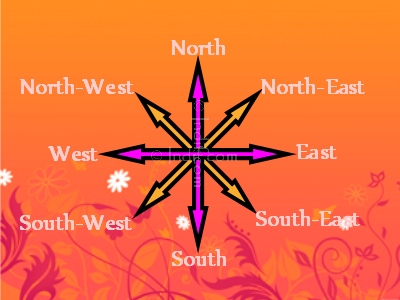
North - Kuber is the lord of this
direction. ,
South - Yama is the
lord of this direction.,
East- Sun
is the lord of this of this direction.,
West
- Varun is the lord of this direction.,
North-East (Ishaan),
North-Westrth-West (Vayavya),
South-East
(Agni) and
South-West (Nairitya).
Vastu Shastra and Feng Shui:
Vastu Shastra and Feng Shui are very similar
concepts. Difference is that Vastu is an Indian concept
based on ancient Vedas while Feng Shui is of Chinese
origin. They have their own laws and principles. Both
use a number of different approaches to connect with the
energy or "feel" the place. Vastu is based on science.
Feng Shui is based on local geographic considerations
and traditions. They both utilize the five elements;
however, Vastu uses earth, water, fire, air and space;
whereas Feng Shui replaces earth and space with wood and
metal.
Benefits of Vastu:
It is proven that the layout, design, structure of the place you work and stay has a definite bearing on your mental and physical state. The positive or negative vibes flowing in these structures affect your peace of mind, your smooth functioning, eventually having a bearing on your health, general well being and also on your prosperity. Vastushastra says that if the structure of your house is so designed that the positive forces override the negative forces then there is a beneficial release of bio-energy, which helps you and your family members to live a happy and healthy life. The benefits of vastu shastra from comercial pont of view includes- expansion in business and profit; increases creativity and intelligence; creates a stress free and supporting environment; improves the efficiency of employees.
Vastu also have spiritual benefits like it awakens the urge for understanding the meaning of life and death; evokes the quest for touching something more deep within and without; helps in problem solving ability and power to make right decision; and promotes happiness and healthier frame of mind.
Physically Vastu affects the lives of person providing them good health, comfort, and brings you harmony and fulfillment.
Vastu Tips:
Some useful tips of following vastu shastra are-
- House should be close to a square. The building should be built leaving open space on all sites. Bathroom normally preferred in East.
- South-east corner is the seat of the god of fire, Agnidev. So activities involving fire/heat (Kitchen) should be made in this corner, then only the house will be trouble free.
- Keep the place free from clutter. Always helps.
- Water bodies in north or east are considered good. Bathrooms and toilets should be adjacent to the north- east corner.
- Keep your money in the cashbox that opens towards the north because the north is direction of Kuber who represents wealth.
- The master bedrooms should be in the South West corner of the house.
- Front door should be well-lit that brings energy to the house.
- Pooja Room should face the east or North-East direction
- In a place of worship in the house it is necessary to have open atmosphere. Use marble in the worship room.
- Never put mirror in kitchen.
- Keep the broom and mops out of the sight in kitchen.
- Hang a picture of mountains behind you in the office.
- Never have a dripping faucet or plumbing as it drains the finances of the house.
- Always sleep with head towards South or East.
- Face East or North while eating your meal.
- Green colour is auspicious in North-east.
- Growing bamboo plants in home is inauspicious, so avoid it.
- Avoid using dark colours on the bedroom wall.
- Place crystals in room near you, rose quartz gives peace, tranquility and understanding in married life.
This science is complete in itself.
Happiness to the whole world it can bring
All the four benefits it bestows on you
Rightful living, money, fulfillment of desires and bliss
Are all available in this world itself
- Viswakarma in VaastushastraIndia is a greatly favored land in terms of cosmic beneficence according to the Vaastu aspect of its geographical location. The Himalayas, or Meru Parvat, oversee the whole of India in the likeness of the prime sahasrara chakra in the human body.
-Vedacharya David Frawley
You might also like:

Republic Day (26th January)- India's great national festival.

Independence Day (15th August)- National Holiday in India commemorating the nation's independence.
Gandhi Jayanti (2nd October)- The birth anniversary of the father of the nation, with reverence all over the country.

Children's Day (14th November)- Children's day in India is celebrated on Pandit Nehru's birthday.


