
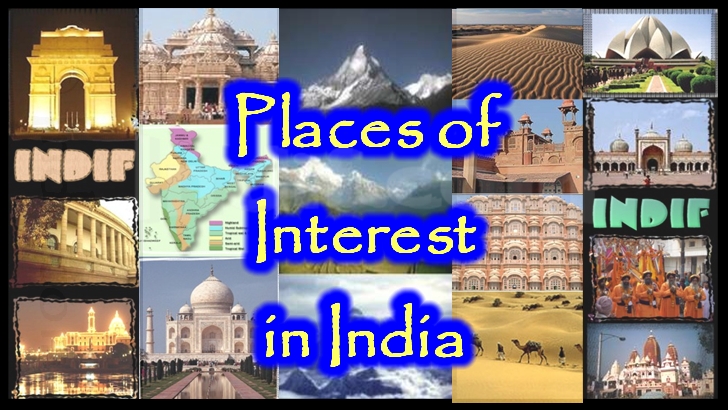
India is an ancient land of vibrant contrasts, with an enchanting maze of culture and tradition known as mordern India. India is a land of dazzling natural beauty from the mighty Himalayas in the north, through the plains of Punjab, over the hills of Assam in the east, and down to tropical coastline of south. It offers a variety ol landscapes, climate, flora and fauna. India is one of the most popular travel destinations in the world and attracts everyone from backpackers, to cultural and spiritual seekers and just those in search of a good time. The numerous architectural wonders in India have a story of their own and are not to be missed. when it comes to tourist attractions in India and places to visit, there is so much to see and do, that travellers are often talking about revisiting this fascinating land.
| Agra | Historic city; location of 17th-century Taj Mahal; Agra Fort; Akbar's Tomb (Sikandara); Dayal Bagh; Jami Masjid (mosque); Tomb of Itmad-ud-Daulah. |
| Ajanta | Complex of about 30 rock-cut cave temples and monasteries dating back to 200 BC; one of the noblest memorials of Buddhism in India. |
| Amritsar | Religious city; site of the most revered Sikh shrine, the Golden Temple with a gold-foil-covered dome; a national monument dedicated to people killed in the Amritsar Massacre (1919). |
| Asansol | Industrial city; center of the Kulti-Burnpur complex of iron and steel, and textile factories. |
| Bhakra Dam | One of the biggest of India, 725 feet (221 meters) high. Part of multipurpose hydroelectric project. |
| Buddh Gaya | One of the holiest of Buddhist sites where Lord Buddha attained enlightenment; a shrine of Buddha dating back to 300 BC; Magadh University. |
| Bombay (Mumbai) | The capital of the new state of Maharashtra, has long been referred to as “the Gateway of India.” In fact, a large ceremonial gateway was erected in 1911 to commemorate the first visit ever made to India by a British king and queen. Mumbai is the glamour of Bollywood cinema, cricket on the maidans on weekends, bhelpuri on the beach at Chowpatty and red double-decker buses. |
| Chandigarh | Joint capital of Punjab and Haryana states; modern planned city designed by Swiss architect Le Corbusier; it is divided into 36 rectangular sections. |
| Darjeeling | Summer resort in the Himalayas; noted for its tea plantations; Lloyd Botanical Garden; Institute of Mountaineering, Mahakal Temple. |
| Ganges River | Great river of the plains of North India; held sacred by Hindus; rising from Himalayas, its course is about 1,557 miles (2,506 kilometers) long. |
| Goa | Natural harbor and tourist resort with a unique Portuguese colonial heritage; 16th-century Basilica Bom Jesus; Se Cathedral; shrine of St. Francis Xavier. |
| Khajuraho | Historical site having a complex of 20 surviving temples of Siva, Vishnu, and Jain patriarchs, dating back to AD 1000. |
| New Delhi | The national capital city is the initiating point for many tourist places in India. Attractions include Appu Ghar, Jama Masjid, Lal Kila, Rashtrapati Bhawan, India Gate, Qutab Minar, Parliament House, Chandni Chowk, Karol Bagh, Connaught Place. During the months of February to April and August to November the city of Delhi has a pleasant climate. |
| Pondicherry | Religious place; Ashram (retreat) of Sir Aurobindo Ghose, noted Indian philosopher and poet; international study center; Auroville, new universal (international) township. |
| Puri | Hindu pilgrimage center; site of the 12th-century Jagannath (Krishna) Temple; annual Chariot Festival. |
| Sanchi | Historic site having best-preserved group of Buddhist monuments, dating back to 300 BC; Great Stupa (shrine). |
| Srinagar | Internationally famous tourist place in the Vale of Kashmir; seven wooden bridges on Jhelum River; Shalimar and Nishat gardens; Dal Lake; Hazratbal Mosque. |
| Tirupati | One of the richest temples in India; believed to be the abode of god Venkateswara; center of Hindu pilgrimage and a fine example of Dravidian art; Sir Venkateswara University. |
| Varanasi | Commonly known as Kashi; the most holy place for Hindus; principal Hindu religious center since prehistoric times; complex of about 1,500 temples headed by the Kashi Vishwanath Temple; Banaras Hindu University; handicrafts, perfumes, and silk and muslin textiles. |
There are some parts of the world that, once visited, get into your heart and won't go. For me, India is such a place. When I first visited, I was stunned by the richness of the land, by its lush beauty and exotic architecture, by its ability to overload the senses with the pure, concentrated intensity of its colors, smells, tastes, and sounds. It was as if all my life I had been seeing the world in black and white and, when brought face-to-face with India, experienced everything re-rendered in brilliant technicolor.
- Keith Bellows (Editor-in-chief, National Geographic Society).In religion, India is the only millionaire……the One land that all men desire to see, and having seen once, by even a glimpse, would not give that glimpse for all the shows of all the rest of the globe combined.
- Mark Twain (American writer).
You might also like:
Republic Day (26th January)- India's great national festival.
Independence Day (15th August)- National Holiday in India commemorating the nation's independence.
Gandhi Jayanti (2nd October)- The birth anniversary of the father of the nation, with reverence all over the country.

Children's Day (14th November)- Children's day in India is celebrated on Pandit Nehru's birthday.


